
Mapping Just Sustainability Transitions in Collaborative Housing
Collaborative housing is becoming increasingly attractive for citizens, industry and policy-makers due to its alleged potential to contribute to ‘just sustainability transitions’, understood as inclusive, affordable and environmentally sustainable housing. From an environmental perspective, the principles of sharing and collectivity underpinning collective self-organised housing forms can have important benefits in terms of decarbonization. However, to understand the potential aggregate impact of these approaches it is necessary to quantify the actual and prospective share of collaborative housing out of the total housing stock. Currently, this data is scattered across national and regional levels, which prevents a comparative understanding of the potential impact of the sector. To overcome this limitation, Co-JuST will build on the existing online data platform CO-LAB MAPPING to visualise the potential aggregate impact of extending decarbonisation approaches in collaborative housing. This will include the study of a subset of collaborative projects to understand their Whole Life Carbon (WLC) emissions, carried out in collaboration with Dr Martin Röck.
In this context, collaborative housing is an umbrella term that encompasses a wide variety of collectively self-organised and self-managed housing forms. These may vary in terms of tenure and legal status, depending on national definitions and policies. Common types include but are not limited to: housing cooperatives, cohousing, Baugruppen, Community Land Trusts, ecovillages, etc. (see taxonomy). To be considered ‘collaborative housing’, a housing project needs to comply with the following characteristics (Czischke, Peute & Brysch, 2024):
- Be intentional (people make a deliberate choice to live like this, they are not forced by necessity)
- High level of resident involvement throughout the project (compared to equivalent conventional housing)
- Presence of shared spaces and shared (social and organizational) activities.
- Collective decision-making by the residents’ group.
- A common vision shared by residents on how they want to live together.
All the above features can be found alongside a continuum depending on the specific project. Projects can be initiated either bottom-up, i.e. by the groups of (future) residents, or top-down.
To achieve the above aim, Co-JuST will pursue four main objectives:
- Improve quality and coverage of aggregated data on collaborative housing projects in Europe.
- Identify and characterise a set of collaborative projects focusing on inclusive environmental sustainability, operationalised in terms of ‘Whole Life Carbon’ footprint.
- Explore the drivers, obstacles and enablers for reducing WLC in a sub-set of Dutch cases.
- Contribute to change the dominant narrative on the assumed marginal impact of collaborative housing by demonstrating the current size and potential growth of the sector (long term objective).
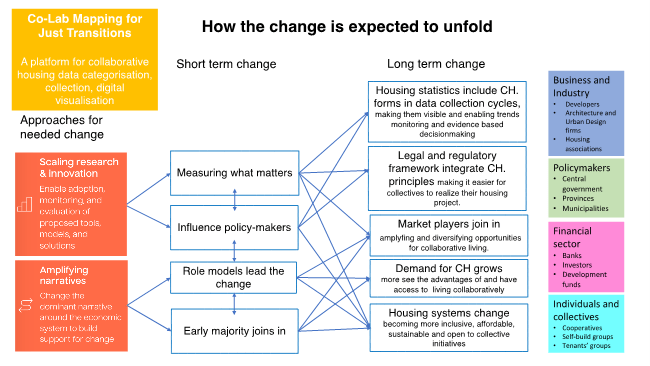
The project is framed as part of a long-term ‘theory of change’ model applied by the CO-LAB MAPPING project, depicted below:
Team
Principal investigator:

Dr Darinka Czischke, Co-JuST Project

Dr Martin Röck, COLA Project / RISE Labs
Research team:

Gabriela Vieira, Co-JuST Project.
Implementing partners: Einszueins Architektur.
Funding organization: Laudes Foundation
 Co-Lab Research